Wanna say something? Don’t be Shy

Start mouthing-off….Shypocket.com, accessed through a smartphone or iPad only, is the new say-what-you-want about your art, his art, her art, nasty art critics, museums, gallery owners.

New opinion site for artists 

http://www.shypocket.com

After 25 years as an ad copywriter and creative director, I had had enough. I was looking for a way out of the confines of commercial writing and the grind of helping clients make money. It was a good career, and now I wanted a good change of career.  You know, the how-can-I-have-fun-for-the-rest-of-my-working-days-and-make enough-to-retire question.

My idea: I’ll make other people write! And I’ll edit them for a change.  In all honesty, I created shypocket.com to fill a gap.

http://www.shypocket.com is an opinion site for professional artists. It’s free. It’s on the mobile –smartphone and iPad only— and it’s kind of cool.

Shy is designed to be a quick, swipe, swipe read of random, daily “mini-essays,” with eye candy under each essay layer. What I want to happen is for the artist community to make this site what it needs it to be—a place for honest, daily discourse that stimulates the mind, the heart, and conversation, against a backdrop of ever-changing topics and points of view.

I also want to prove that artists can write. Beyond the expected stiff (sorry) process statement. Consider this a challenge and send us 90 words + one image on a topic that’s hot for you. What gets you twisted? Stoked? Right now. Every day. Top of mind.  A day in your life with art. Do tell.

Cara Fox, Publisher

get-attachment-1 contact@shypocket.comweisler_sample

Picasso Waxes Metaphysically

“There is no abstract art, you always have to begin with something.” Pablo Picasso

Abstractly speaking, Herbert Siguenza is Pablo Picasso. He fully embodies the man on stage.  The opening scene finds Siguenza, writer, artist in his own right, actor and ‘Picasso’ in his bathtub. The audience has no doubt that the tan, white haired, stocky man waxing metaphysically from his bath, is indeed the man known simply as Picasso.

If you’re waffling on taking in this production at the DCPA don’t over think it, just go. Especially if you love art, Picasso, impressionism, cubism, color, and an hour and a half inside the head and studio of the artist everyone knows and loves.

A Weekend with  Pablo Picasso is truly enjoyable. Siguenza is superb as the fiesty, outspoken, genius artist. I learned a few things about Picasso I didn’t know, such as his passion for social issues spoken within the context of his life. The labor of love, by Siguenza, spans three days in Picasso’s studio in Southern France as he works non-stop to finish six commissioned works by Monday. Intuitively, Siguenza created the intimate weekend by involving the audience.  Throughout the 90 minute soliloquy the artist is talking to his audience, distance relatives who have dropped in unexpectedly. He doesn’t have the time or energy to ban them from his studio and in time welcomes the company as he reveals much of his life and personality on stage.

You’ll hear bits and pieces of Picasso’s life, his children, wives, lovers, his eating habits, revealing many traits everyone knows like writing checks for everything no matter how small the amount because, no one ever cashes them.  The evening conversation is intertwined with his original quotes formulated as if for the first time. It’s all very creative and personal acted out in an original studio set you would want Picasso to have.

550004_10151295128171854_963322594_n 2012-05-04%2023.42.06

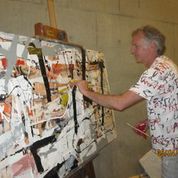
Jeff Wenzel, from Art Students League of Denver, painting in theatre before play opened.

Plays The Ricketson Theatre through April 28, 2013. http://www.denvercenter.org. Box office 303-893-4100.

Sally Stockhold’s 3-Lens Circus

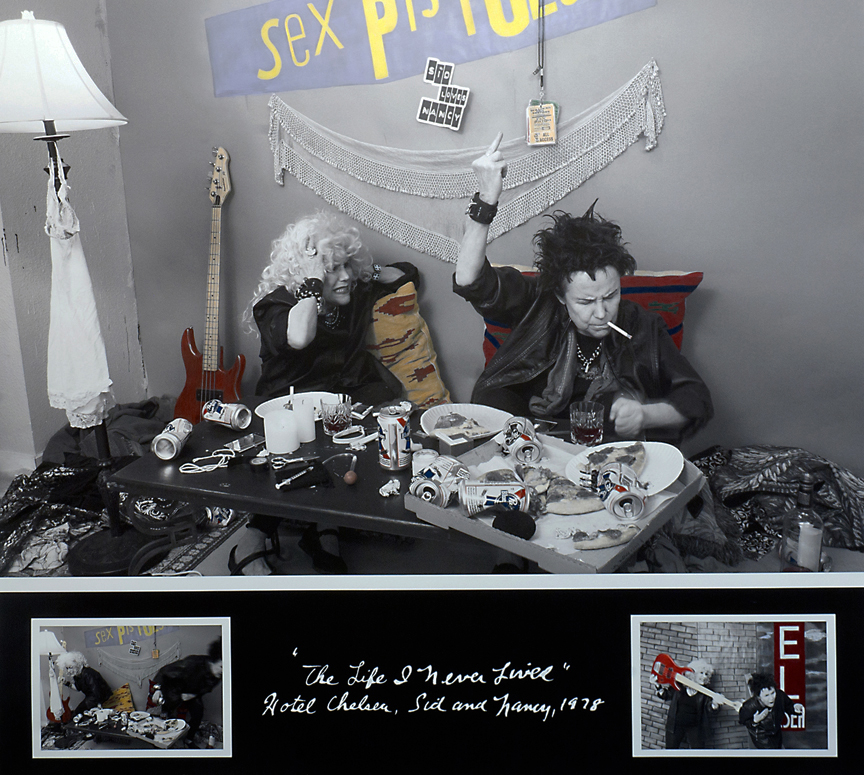
new-warhol-hi-res_1Sid-&-Nancy-hi-res_newest_copy (1)

March was designated the Month of Photography (MoP) in Denver. What a huge success it has been for photographers and galleries. Denver’s best shooters were hung or wheat-pasted on walls, on sides of buildings in downtown, the Santa Fe Arts District, The Museum District, in alleys, in high-rise office buildings, in university and neighborhood coffee shop galleries.

Sally Stockhold is not your run-of-the-mill fine art photographer. Her unforgettable work is part stage, part social commentary, playful but never frivolous, and should be considered some of the most important work coming out of Denver’s art community.

“It’s fascinating to embody the women I admire.” Sally Stockhold

At The Metropolis Coffee Shop where we met, Sally and I were chatting about her life prior to living in Denver. We quickly ran through the early years at Cooper Union Art School at New York University graduate film school, the years of commercial freelance photography and film work, her two husbands, children, and her academic segue into photography from a painter, when it dawned on me. Her enormously clever photography style made sense. In only a short time I had learned this artist could stand behind a camera with ease; she could stand in front of the camera if portraying another person. The key to Stockhold’s talent and drive is her intense shyness and a life-long attempt to overcome stage fright. “You’re a frustrated actress,” I said. Her eyes focused on mine:  How did you know?

From the first time I saw a Sally Stockhold photograph her talent lodged in my subconscious. Much like the first time I saw a Nan Goldin show in San Francisco or a Diane Arbus book of photographs. All three artists astounded me with their uncanny unveilings of the human psyche. With careful observation the artists are masters at revealing raw pain, love, sadness, loneliness, playfulness and escapism found deep in the souls of other people.  To encounter Stockhold’s work is like finding a cherished old book or a vintage photo to crawl into. There is something familiar and intelligent and you know there’s a story lurking under the thin veil of disguise. Her work engages. It’s difficult to walk away from it.

Recently I ran into her work, during MoP, at the Walker Fine Art Gallery and her new series, “The Life I Never Lived.” This series is where Sally (subconsciously) does what she wants to do – perform a one woman play, playing every character in costume.

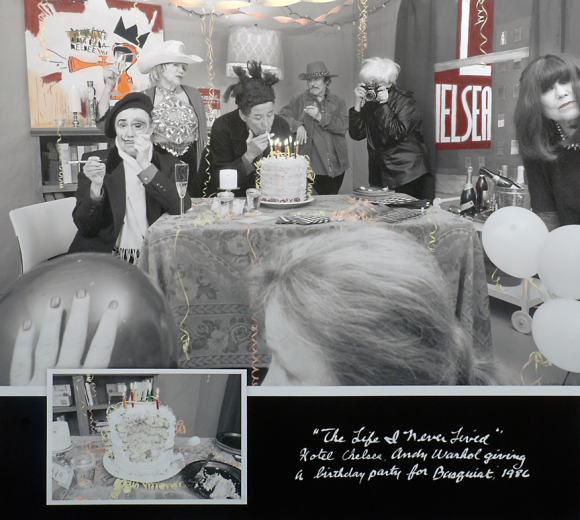
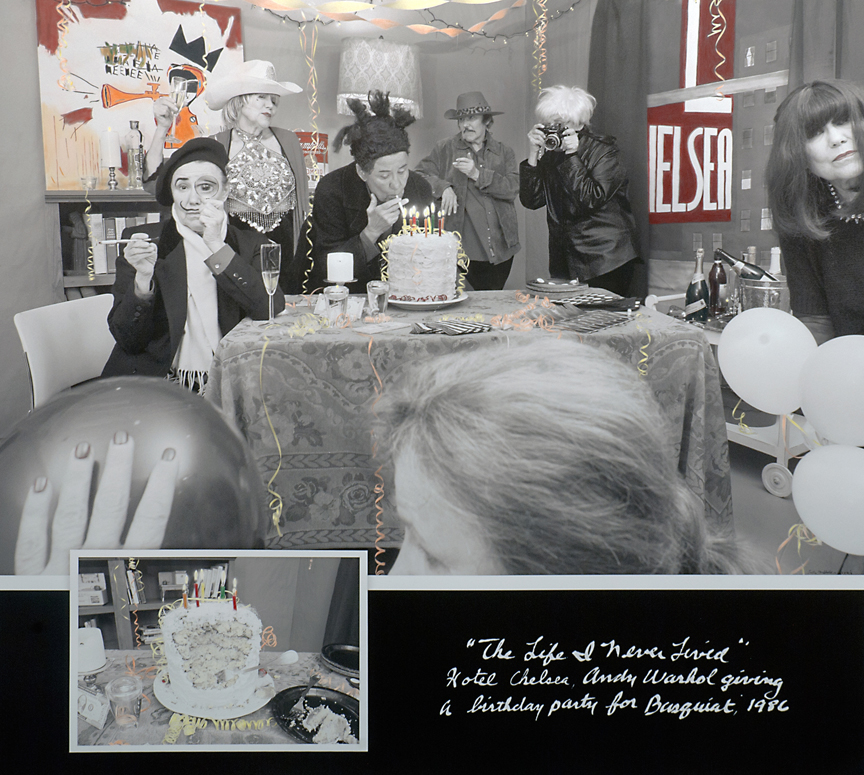
She talked about how she accomplished this brilliant feat, explaining, that the visual narrative comes first. Once the theme, characters and costumes are found, she paints a back drop or stage setting and meticulously blocks out each character’s position for the carefully posed final shot. Look closely at Andy’s Birthday Party for his friend, Jean-Michel Basquiat.  Sally is posing as each character. Her uncanny and excellent portrayal of each personality, is astonishing. Even though I know it is she, always for me, the final scene is a shake-my-head-surprise reaction. It never fails, on second or third glance one succumbs to the mind’s eye, you’ve been tricked.  Shaking off your confusion, and clearing the brain, you must admit to yourself, you thought each actor was a different person. Pure genius. But it’s Sally, Sally. Proof, she is not only a visual artist but an accomplished character actor as well.

DAM: Please, in your own words,  give us a run-down of how you accomplish so much in one photograph.

Sally Stockhold: It’s a ton of work. I am a painter first, so before the shooting begins I paint background scenes on huge sheets of photographer’s back drop paper where I include peripheral decor such as a window (see the Chelsea sign outside this room) or, a painting on the wall to set the tone. In the preliminary stage the camera is set up, I check for images, size, ratio, lighting. I run back and forth from behind the camera tripod to my character’s pose and when every thing, including the set and costumes are ready, I pose for the photo, my sister steps in and snaps the pic, about 12 at a time.  I step out of the set and examine the shots and continue shooting until I’m satisfied that I’ve captured the character.

DAM: The Chelsea series seems especially grueling due to the number of characters in each finished photo.

Sally Stockhold: Yeah, I’m probably going back to the ladies series after this. I love researching women. But on this, I just didn’t have as much time as I thought I had and I didn’t get started when I should have. Consequently, I worked day in and day out. One photo took three weeks. I worked 12 to 16 hours a day to finish by the end of February.

DAM: What type camera did/ do you use?

Sally Stockhold: Most people would call it a doorstop. I use a Nikon D200. [Smiling] It makes a lot of photographic noise in my enlarged prints.

DAM: It certainly works for you. But how do you piece it all together? What is the process for combining all the shots to create the final piece?

Sally Stockhold: It’s what you call hands-on work. After shooting I print all the characters exactly as I shot them. I cut each character out and create a composite paste-up of the photograph. I put extreme effort into each photo in order to get the shot right the first time. So there is little to do except “stitch”  the story together in photoshop. The photograph is then printed on inkjet watercolor paper.  The last step is when I selectively hand color each photograph with prismacolor pencil and pastels.

DAM: Diane Arbus said, ‘My favorite thing is to go where I’ve never been.’ When you lived in and around the village, 1964-1986, did you ever live at the Chelsea?

Sally Stockhold: No. That’s why I created ‘The Life I Never Lived’  series. I used to walk in front of the Chelsea every day. I still wonder why I never walked inside.

DAM: Who or what are your next subjects or theme?

Sally Stockhold: I want to go back to the ladies, “My Self Portraits.” (“myselfportraits, ode to icons”). It’s fascinating to embody the women I admire, much harder to be the person in real life.

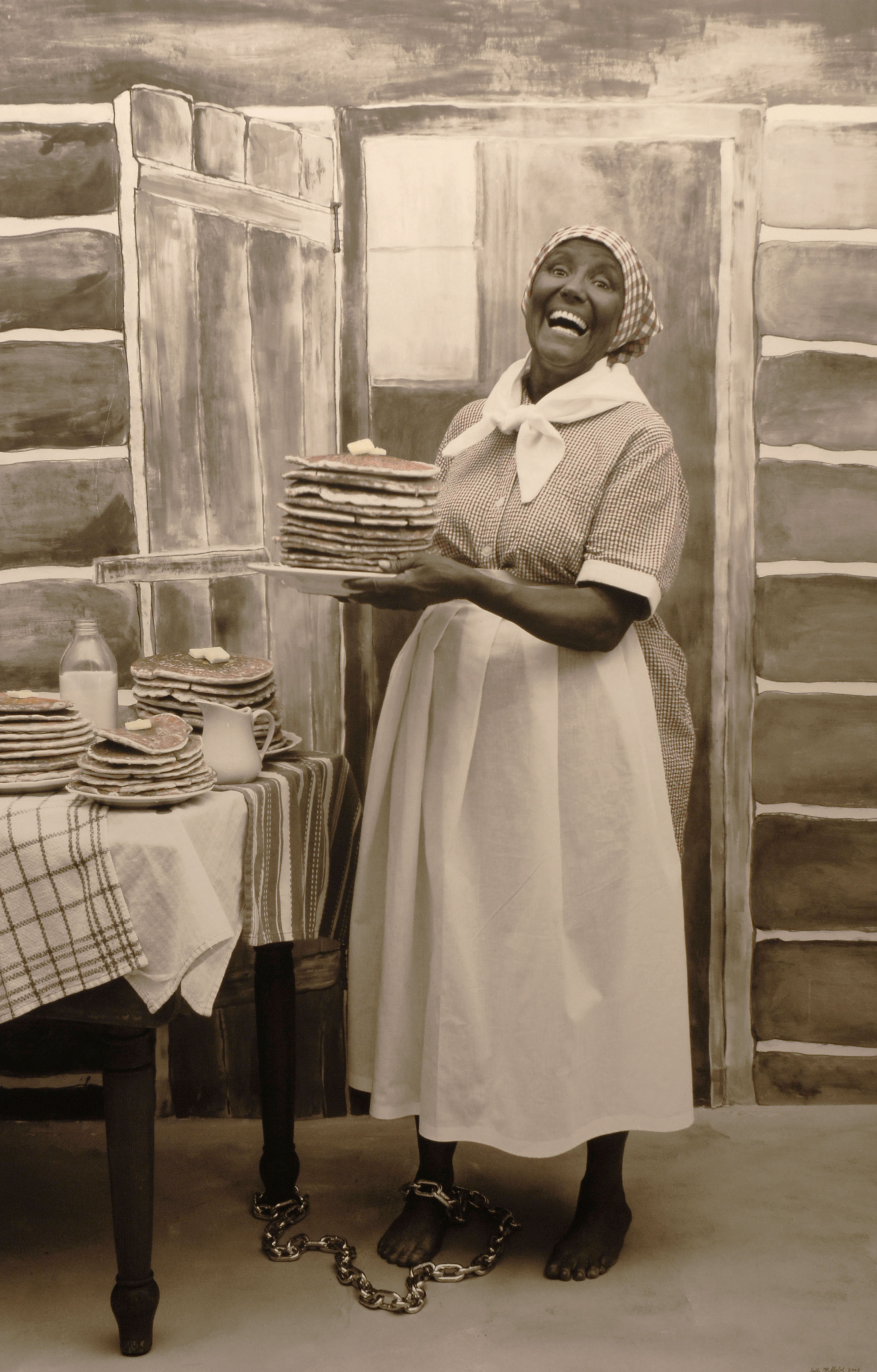
Aunt_Jemima_-_I_laughed_because_they_paid_me (1)      Aunt Jemima

Ethel_Rosenberg (1) Ethel Rosenberg

IMG_2436

Sally Stockhold

DAM: How do you keep all the characters straight? Do you live as your characters to acquire their facial similarities, i.e., Aunt Jemima, Nancy or Andy Warhol as you prepare for a new series?

Sally Stockhold: It’s a very schizophrenic life I live. With this show I was fretting over a shot of Andy when I told my sister, ‘I need to take another shot of Andy.’ I find I separate myself from the characters and speak of them in the third person, as if they’re someone I’d call up to come back to the studio for a reshoot.

DAM: Next?

Sally Stockhold: I want to get outside my element, outside of Denver.

DAM: “The Pope?”  [that day, the world was awaiting the white smoke]

Sally Stockhold:  Hmm. I could become the Pope. I left the Catholic church. That’s a great idea.

DAM: I was wondering, have you ever been compared to Cindy Sherman?

Sally Stockhold: All the time.

See Sally’s work at The Walker Fine Art Gallery, 300 W. 11th Ave, Denver 80204, 303-355-8955

Creatives Unite online

It’s safe to say that social networking today is the once had-to-be-in Chamber of Commerce.  If you’re in business you know you have to be on Facebook, Twitter, Linkedin, Pinerest, period. People want to type in your name, see your face, your work, your birth date and your business resume. Hipster entrepreneurs have it easy, no Wednesday business lunches, mandatory brainstorming sessions in order to grow the chamber membership, or monthly dues or endless meetings with people you would never sit in the same room with under any other circumstance.
IMG_2070
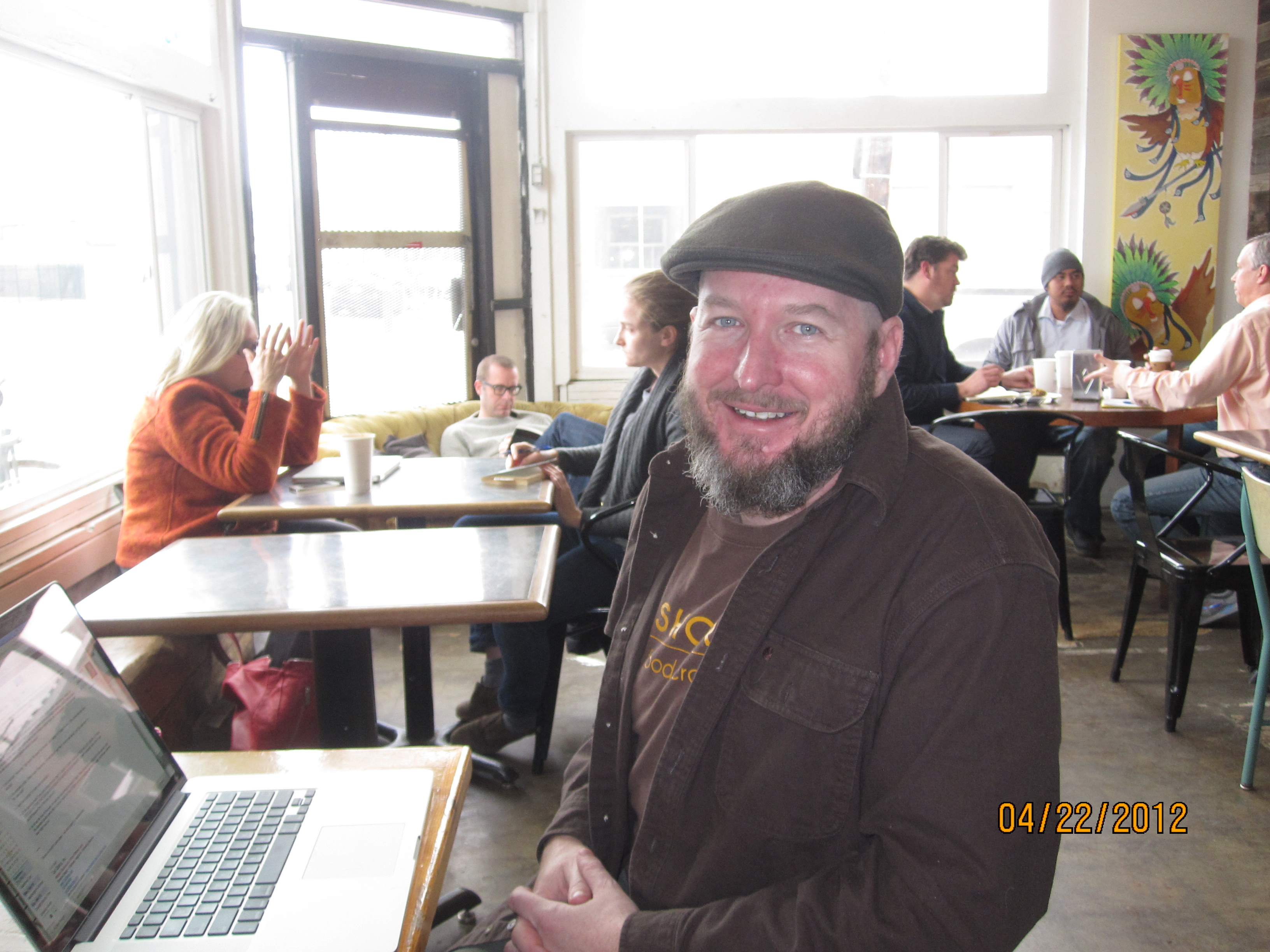
Scott Nash (above) needed a network and he searched. He couldn’t find what he foresaw as the ultimate way to connect with peers. So, he created perhaps the only model for an online chamber of commerce where clients and colleagues can find a person in one click and determine with a yes or no a future working relationship.
His vision was to have a portal for creative people, i.e.,  an online directory, if you will, populated by professional profiles. His goal was for connecting individuals, businesses and ideas into an active network for artists and other creatives from a wide variety of industries. Relying on his experience and years creating/designing networking opportunities for the community, Scott developed ConnectwithCreatives.com, an online 24/7 networking connect site. Here’s how he explained it last week as we sat in the Crema Coffee Shop at 28th & Lawrence and drank their dark coffee and delish chocolate croissants.
____________________________________________________________________________________________________________
The definition of how we do business today. 
 
A social networking service is an online service, platform, or site that focuses on facilitating the building of social networks or social relations among people who, for example, share interests, activities, backgrounds, or real-life connections. A social network service consists of a representation of each user (often a profile), his/her social links, and a variety of additional services.  from the internet
 ____________________________________________________________________________________________________________
DAM:  Tell me about Connect with Creatives.
Scott: I launched ConnectwithCreatives.com at the Create Denver Event last May (2012). It was an off shoot of my ‘Tall Zebra’ internet design & development company. Because I wanted and needed creative connections, I thought it was time to bring together an assortment of individuals to learn about other creatives through an online directory/website.  CwC was started from scratch. I came up with 33 creative categories like design, film, theatre, writing, promotion. It was my intention that each user to be able to list three categories under their name, because today, we all know, creatives can and do everything from writing scripts to cartooning all in a day’s work. Just ask one.
DAM: People will want to know the price and how it will benefit them. Do you have free listings?
Scott: There is a free listing option, but most people opt for a SPOTLIGHT listing, which has a one time set-up fee of $44. This includes a photo and profile. Members create their profile with a bio, photos, career history or business and services description. Each member is invited and informed of upcoming networking events and encouraged to do a presentation and promote their business at these get togethers. We’re expanding opportunities already. In March, I am launching the companion website ColoradoCreativeNews.com. This is where members can post articles, press releases, events or crow-funding projects and allows people to quickly view the SPOTLIGHT profile of the contributor. It is an easy way for creatives to get their name out there, all while helping promote news pertaining to the creative community. CCN will also serve as storage for press releases, an online resource for publications and, we’ve set up a way for creatives to make money from referrals.
DAM: Tell me more about the free listing option.
Scott: It is minimal information but all the same, CwC is a site where I expect clients to search for creatives as well as services. If you are in the business of creativity, I encourage you to go to www.connectwithcreatives.com and at least input your name, business and talent/s on the free listing page.
DAM: How much research did you do before creating this site?
Scott: I looked for months for something like Connect with Creatives and found nothing. It was my desire to connect with other creatives that led me to designing CwC. The purpose of CwC is for creative people to stay in touch with each other, and help each other connect. That’s what I wanted initially. So I started it myself.
DAM: Any success stories yet?
Scott: Yes, People love that it’s unique and just about creatives. There’s Norman Dillon, a photographer in the RiNo district, who has gotten business from the CwC website, Vicki Hazelett, a video editor is very pleased and, Laura Copperthwaite, a real estate agent for artists is happy to be able to stand-out in the creative community. With the launch of ColoradoCreativeNews.com, I suspect we’ll hear more successes. I think creatives will have to get more creative and find the extra time to promote themselves with press releases on CCNews.
DAM: Where do you see Connect with Creatives in five years?
Scott: I hope to develop other sites such as this for other major cities.IMG_2074
office of Connect with Creatives in Lower Downtown
Connect with Creatives is a unique gathering for like-minded professionals geared specifically to appeal to artists, designers, stylists, photographers, writers and their need for self promotion.

Swine, Swindle & Shutter ends February, 2013

It snowed all day yesterday, but I saw purple and yellow crocuses blooming Sunday. I’m sure spring is close, I had the first whiff of thawed earth this weekend. Winter is waning I know, because PR people are sending out ‘Mark Your Calendar,’ releases to the media informing us the party is starting. And so it is, the best time of the year in Denver is revving up.

Swine Tasting

IMG_2172  Chef Justin Brunson

It was beautiful last Wednesday when I went to the new restaurant, Old Major, for a media food & wine tasting. The name Old Major was taken from the boar in George Orwell’s Animal Farm. From start to finish the only thing I could complain about was the bright, hot sun beaming down on me, and only me. There was nothing to do but suffer. The manager felt my pain and stood so that his head shielded me from the brightness here and there, but until the fireball went down, I was in the sun light, and, though I know better, I wore my sunglasses throughout the food and wine tasting. The lastest hippest foodie restaurant is in LoHi, 3316 Tejon, I expected an older home to house the so-called rustic kitchen. The building at one time was a roller rink but I saw no evidence of that. The interior was redesigned in dark rustic, wood, brick & glass, using the kitchen as the center piece. Diners can see through the glass partition to the working kitchen. The food being prepared in there rocks. Like South Carolina’s new wave of chefs, such as Sean Brock, whose rule of thumb says every item served must be grown in, and have historical relevance to the region, Chef Justin Brunson, while not a Southerner, is from the same school of thought. Even though Colorado is not as rich in year-round vegetables and herbs, the staff and chef focus on serving food from local farms with no genetically engineered vegetables or grains, and they are basing their reputation on serving heritage-raised meats. Old Major is innovative. They’ve introduced the idea of nose-to-tail butchery. That means every part of the animal has a purpose and distinct flavor. The last dish served to the slathering media, before the thick, silky, creme brulee arrived garnished with a crisp, flavorful strip of bacon, was a thick juicy pork chop from Zimmerman Pork Farm in Hotchkiss, Colorado. It was to die for. With the advent of the Food Chanel, food has become a fine art form that everyone can enjoy. Like all artists, today’s chefs must be educated about their craft, knowledgeable of their region’s bounty of food and know what’s available in what month. But it’s overseeing quality first that is the test of artfulness. Using Sean Brock’s recipe for the PIE Theory, it’s evident Chef Brunson is on top of the formula for fine, tasteful dining. PIE = Product, Inspiration, Execution.

IMG_2177         Pork Chop from Zimmerman Pork Farm

IMG_2179   Old Major kitchen

Catch Me If You Can

After a delightful 2 hour Old Major’s experience, I raced over to the Denver Post for a presentation by authors, then left early to get to the Buell Theatre for “Catch Me If You Can.” I love musicals. This one was zippy and fun. There was something less-highly-polished about this production compared to say, “Memphis.” It could have been that the trucks carrying the sets were stranded in Kansas due to the weather, so opening night was Wednesday instead of Tuesday. When it comes to the story behind this brilliant but unlikely con man, most people like to add that, ‘He shouldn’t be applauded for his crimes.’ I find it fascinating. Without doubt, Frank Abagnale, Jr., was a world-class con-artist. It’s hard to believe that a 16 year old young boy/man, was able to convince professionals that he too was a professional pilot, doctor, lawyer. In real life, Frank must have been a natural, handsome charmer. In the Denver production, Stephen Anthony / Frank had me convinced. He was equal parts engaging, cute, well-mannered, curious, innocent and he capably carried off the character of a young boy in trouble, sinking deeper over his head, but doesn’t know how to stop doing the bad things he got himself into by mistake. Stephen Anthony could sing and dance to boot. It was fun to watch even if the entire production was a bit road weary. There was a rhinestone or two missing on opening night but, perhaps the real problem was they just didn’t have time to get their costumes cleaned and sparkling for a delayed opening night.

Catch-Me-Logo

It was First Friday, March 1, 2013

IMG_2193         Gallery 1261, artist Heather Neill

IMG_2189   At Gallery 1261, 1261 Delaware,

My fav art peeps:  artist, Daniel Sprick, art consultant, Candice Pulliam, sculptor, Jay Eighmy.

IMG_2182   Space Gallery, Santa Fe Art District,

ICONS, artist William Stoehr

IMG_2185   Deborah Jang, multi-media,

Carson Gallery, An Exhibit Space of the Art Students League of Denver, 700 Santa Fe

new-Warhol-hi-res_1  In keeping with the March theme, Month of Photogrpahy, at Walker Fine Art, 300 11th Avenue, my choice for best-of-night was photographer, Sally Stockhold and her “The Life I Never Lived,” series.  This woman is amazing. Notice, every person in the shot is my favorite artist, Sally Stockhold.

We also stopped at Byers-Evans House Gallery, CHAC, Artists on Santa Fe, Goodwin Fine Art Gallery.

Tagged , , , , , , ,

Shutter month in Denver

index   THE REALITY OF FICTION

Reality%20of%20Fiction

Image: Reiner Riedler, from the series Fake Holidays: Horizon #1, Tropical Islands, Germany, 2007,
Represented by Sous Les Etoiles Gallery NYC

The Reality of Fiction

The realities and absurdities of our modern age
Curated by Mark Sink
Exhibition Dates: March 8 – April 28, 2013
Reception: March 8th 2013,  7-10 pm, Members 6-7 pm   

A survey of photographers work who explore the subject of reality and fiction in this new millennium. From serious social documentation to humorous and absurdities of our modern culture.

This survey of fake will consist of portraits of extreme plastic surgery, hyper realistic fake babies, fake holidays, fake relationships, fake realities, UFO Polaroids and much more.

Participating artists:

Emily Peacock – Reiner Riedler  – Phillip Toledano – Sarah Martin – Sally Stockhold – Rebecca Martinez – Greta Pratt  – James Soe Nyun – Joe Clower – j.frede  – Katie Taft – John Bonath –  Christine Buchsbaum – Conor King – Michael Ensminger –  Edie Winograde – Pablo Gimenez Zapiola – Lori Nix – Liz Greene – Harry Walters – Adam Milner – Sarah Haney – T. John Hughes – Nina Berman – Susan Anderson

Related Programming

Artist Lecture – March 9, 2-3 pm

Artist Rebecca Martinez will walk and talk about her series PreTenders.

Portfolio Reviews – March 23 – 24, 11 am – 5 pm

Intensive portfolio review sessions are available with gallery and museum directors, curators, photography collectors, teachers, critics and editors. Student and professional fine art photographers will have access to experts who can influence and advise on current marketing and offer image-world knowledge. For more information or to sign up for Portfolio Reviews:http://mop2013.blogspot.com/2012/11/portfolio-reviews-march-23rd-24th-2013.html

Action Figures – March 24, 6pm

A participatory performance and discussion on photography

“Musical Chairs” by Katie Taft and Don Frank

APA Lecture – April 25, 7 – 9 pm

Art Photographers of America presents Jackie Shumaker, with a lecture on copyright law and licensing your work in today’s world of the internet.

MoP – Month of Photography Denver is a celebration of fine art photography through 100+ collaborative public events throughout Denver and the region for the month of March – April 2013. We are joining multiple museums galleries and schools surrounding ideas in fine art photography creating an exciting artistic and educational event for the city of Denver and the region.

For more information on Month of Photography events throughout Denver, please visit www.mopdenver.com 

RedLine is a 501(c)(3) public charity.
©2013 RedLine | 2350 Arapahoe Street, Denver CO 80205 | tue-fri 10-5 : sat-sun 11-5 | directions | 303.296.4448 | info@redlineart.org | find us on facebook

design: ishmael hallin.

Tagged , , ,

Who follows our Facebook Page?

IMG_2184

Art People at the Sandy Carson / Denver Art Students League Gallery on Santa Fe, March 1, 2013

I bet you’re saying to yourself, it’s about time Denver Art Matters posted something. Has Jan turned into a slacker?

If you’re asking that, I know you’re not a Facebook fan and you’re not following my Denver Art Matters Facebook page. If that’s you, let me explain.  I find it informative to follow FB pages from museums, art districts, artists, galleries, and momentous blogs. The ones that I follow highlight interesting art stories that include links on extraordinary art journeys from the world of art.  If you are following us on Facebook you know I’ve posted a lot of information on the Month of Photography in Denver. If you were interested in visiting the galleries featuring photographers, it was posted on the Denver Art Matters Facebook page.

Here’s the hoedown. Facebook like it or not, is the social media / networking portal sharing information on every subject under the sun. It’s no wonder newspapers and magazines are suffering.  Posts from Facebook, Google +, tumblr, wordpress, blogspot, etc., travel effortlessly to your screen with timely information from Denver to Denmark. I follow many blogs that interest me because as a self appointed Denver art blabber it’s my job to bring my readers the most important art stories in Denver; Colorado, and the world. If you are reading this and you’re not on Facebook, it’s difficult to explain how it works. Let me try. For instance, I follow the Museum of Contemporary Art Facebook page. When they post a new exhibit or lecture on their page, it automatically shows up on my personal Facebook feed. When I see it, if I like it and want to share it with my readers, I click ‘share’ to my Denver Art Matters page. DAM followers see it immediately. Unfortunately, I may not recreate their post on my blog www.denverartmatters.wordpress.com. If you follow my DAM wordpress (thank you for that) and not the Facebook page, you would not see the post about the upcoming MoCA event on my wordpress Denver Art Matters blog. Is this complicated?  Here’s another example,  I saw the MoMA post about Jasper Johns & Robert Rauschenberg the day before I posted it to my DAM Facebook page.  I never recreated it for my blog. Reason being, by the end of the day, it was too late because the cyber world had already heard the question about putting the two artists back in the closet. It may appear unfair that someone creates a meaningful, newsworthy, important post and then I repost it to my readers.  However, the rules are different in social media.  Sharing is encouraged, that’s where the word exponential comes in – rapid travel.  If a news item is posted on Facebook, the post originator hopes many people, like me, share it with you. When a news item is synced the post will go back at some point to the original author, therefore going viral or – spreading exponentially.

Whew. I’m trying to explain this in layman terms. If you’re not following Denver Art Matters Facebook page I wish you would. My intent with this post is to explain why my blog sometimes seems inactive, yet my Facebook page is constantly updated. I want you to see the latest Denver Art babble and I’m working to present that to you. If you’re not a fan of the Denver Art Matters FB page – please go there and click LIKE. That will send you all the news I post immediately.

IMG_2196

Walker Fine Art, Denver, March 1, 2013.

Friday’s Big Question

Do you know this sculptor and his work?

IMG_2067

Hint:

He’s in tune with Africa and it’s animals. Known as one of Denver’s classic sculptors, who most assuredly will go down in the pages of  Colorado and American art history.

His studio is in LoDo.

Ticket to Colorado History Museum to first correct answer.

Sculptor: _______________

Great Sunday read

“I Noticed My Friends”: Allen Ginsberg’s Photography

Allen Ginsberg, "Myself seen by William Burroughs..." (1953, printed 1984–97). National Gallery of Art, Gift of Gary S. Davis.  Images (All images © 2012 Allen Ginsberg LLC. All rights reserved.)

Allen Ginsberg, “Myself seen by William Burroughs…” (1953, printed 1984–97). (All images National Gallery of Art, Gift of Gary S. Davis; © 2012 Allen Ginsberg LLC. All rights reserved.)

In his poem “America” (1956) Allen Ginsberg addresses the nation as if it were a codependent lover, asking, “Are you going to let your emotional life be run by Time Magazine?” followed immediately by the confession, “I’m obsessed by Time Magazine. I read it every week.”

This combination of confrontation, wit, ferocity, self-examination and intelligence remain exceptional qualities in American poetry, even today. However, since his death in 1997, Allen Ginsberg’s celebrity overshadows his poetry. No wonder. He was arguably the most public poet in all of American history. He was the award-winning counter-culturist, a pioneering leader on gay rights, an outspoken opponent of the police state and its techniques of lies, repression and censorship, the godfather of spoken word and street poetics, a teacher and supporter of up-and-coming poets and artists as well as a spokesman for neglected peers. He was a conscientious objector, the practicing Tibetan Buddhist who never quite left behind the pragmatic chutzpah of his native New Jersey, or his Judaism, emerging in the 1960s as an often interviewed advocate for far-left progressivism in an age of American reactionary politics.

These days Ginsberg’s poetry isn’t completely neglected. But its content and range are subsumed by the legacy of these famous interests, many of them propagated in documentaries over the last few decades and even in film adaptations of his life, like the recent Howl (2010) and On the Road(2012).

At first glance, Beat Memories: The Photographs of Allen Ginsberg at the Grey Gallery seems like yet another nostalgic trip that will further eclipse the poetry. In actuality, this exhibition of 94 black-and-white photographs, taken by Ginsberg in the periods 1951–1963 and 1984–1996 offers a chance to reassess Ginsberg as an introspective poet who cultivated patient and caring witness even as he lived forcefully and at large. Overall, the photographs reflect a documentarian’s attention to an epoch’s unpredictable arrival and then, more subtly, an equal and more complicated attention to that same generation’s fadeout.

Because I began viewing the show at the wrong end of its neatly curated timeline, the first picture I saw was a harrowing portrait of Ginsberg’s aunt near death in late 1980s, followed by a photograph of his lover Peter Orlovsky, seated alongside his family near a social welfare office on Long Island. Ginsberg’s portraits of Orlovsky are highlights of the show as they correspond to the changes of period and lifestyle, permutations reflected in Orlovsky’s mysterious shape-shifting appearances. He emerges as muse and marks the site at which Ginsberg’s private life bleeds into the public.

Ginsberg’s almost paternal pride in the poet Gregory Corso is a subject of a number of photographs. Ginsberg discovered Corso shortly after the latter had served a three-year stint in Clinton Prison for theft. A serene photograph shows a seated, confident Gregory Corso — his overcoat draped over his shoulders, his hand holding a curtain rod like a weapon — underneath a sunlit window frame in a Parisian garret. The image provides a startling contrast to a close-up of a tired and rotund Corso which Ginsberg snapped in the mid 1990s at Kettle of Fish bar. Similarly, two separate photographs of Jack Kerouac crystalize the peripatetic drive of these young poets and writers long before they had been loaded down with the media label “Beats,” a label that curator Sarah Greenough expediently if unfortunately perpetuates in the exhibition’s title.

The vitality of their youth is hard to miss. Even the young Ginsberg living through it sensed its inimitability. A rooftop photo of clean-shaven bespectacled Ginsberg taken by William Burroughs shows the poet against a backdrop of television antennas, chimneys, and skyscrapers. A photo of Jack Kerouac shows him mugging an “Om” as he strolls by Tompkins Square Park in 1953, and, in another, from that same year, Kerouac is in profile, silhouetted against the granular wood boards of the Staten Island Ferry pier, like an extra from Kazan’s On the Waterfront.

Allen Ginsberg, "Jack Kerouac wandering along East 7th Street after visiting Burroughs at our pad, passing statue of Congressman Samuel "Sunset" Cox, “The Letter-Carrier's Friend” in Tompkins Square toward corner of Avenue A, Lower East Side; he’s making a Dostoyevsky mad-face or Russian basso be-bop Om, first walking around the neighborhood, then involved with The Subterraneans, pencils & notebook in wool shirt-pockets, Fall 1953, Manhattan." (1953), Gelatin silver print, printed 1984–97 11 1/2 x 17 3/4 in. (29.2 x 45.1 cm), National Gallery of Art, Gift of Gary S. Davis © 2012 Allen Ginsberg LLC. All rights reserved.

Allen Ginsberg, “Jack Kerouac wandering along East 7th Street after visiting Burroughs at our pad, passing statue of Congressman Samuel ‘Sunset’ Cox, ‘The Letter-Carrier’s Friend’ in Tompkins Square toward corner of Avenue A, Lower East Side; he’s making a Dostoyevsky mad-face or Russian basso be-bop Om, first walking around the neighborhood, then involved with The Subterraneans, pencils & notebook in wool shirt-pockets, Fall 1953, Manhattan.” (1953). Gelatin silver print, printed 1984–97, 11 1/2 x 17 3/4 in. (29.2 x 45.1 cm).

In hindsight, those two youthful photos become a prologue for Ginsberg’s wrenching 1964 photograph of a candid, disheveled Kerouac slumped in an easy chair surrounded by luggage in the poet’s East 7th Street apartment, staring away from the camera as if in self-disgust. The now world-famous Kerouac looks, in the captions scrawled by Ginsberg, like “WC Fields…red-faced corpulent shudder with mortal horror.” Here, the photo seems to say, are the strange fruits of fame.

Although the exhibition is crowded by some already iconic images, like novelist Paul Bowles seated barefoot on the ground in Tangier looking up from a bowl and spoon, the show’s strongest appeal is the incidental and often euphoric moments that Ginsberg preserves: Orlovsky sky-high as he cannonballs upside down into a pond in Cherry Hill; Poet Gary Snyder, crew cut and priestly robed, flashing an ironic yet innocent gaze from a lush Kyoto garden; Keith Haring, like a schoolyard showman, drawing on a sidewalk in Lawrence, Kansas; Lou Reed backstage at the Public Theater unwittingly gazing in the precisely opposite direction of Samuel Beckett’s visage on a nearby playbill.

A few photographs transcend their well-known subjects and suggest that had Ginsberg decided to give up writing poetry, he might well have made a run at being a full-time, master portraitist. And like the cameraman himself, the pictures traverse the globe: Japan, India, Morocco, Paris, Zurich, New York, Yosemite, San Francisco. A self-portrait reflected through multiple angles and mirrors taken at an optometrist’s office in the 1980s exhibits an almost indescribable facetiousness, much like Ginsberg’s long-distance shot of a skinny, isolated and atypically vulnerable William Burroughs, his boney head bowed under the spotlights as he prepares to be filmed for an interview. Burroughs is perhaps the most overexposed subject of the photographs, but there are fortunately many surprises.

Allen Ginsberg, "Francesco Clemente looking over hand-script album with new poem I’d written out for his Blake-inspired watercolor illuminations, we’d done two books before; entrance corner of his loft overlooking Great Jones Street Manhattan, October 1984. He liked this picture." (1984) Gelatin silver print, printed 1984–97 15 7/8 x 10 5/8 in. (40.4 x 27 cm)

Allen Ginsberg, “Francesco Clemente looking over hand-script album with new poem I’d written out for his Blake-inspired watercolor illuminations, we’d done two books before; entrance corner of his loft overlooking Great Jones Street Manhattan, October 1984. He liked this picture.” (1984). Gelatin silver print, printed 1984–97, 15 7/8 x 10 5/8 in. (40.4 x 27 cm).

A marvelous picture of the painter Francesco Clemente shows him seated in front of an oversized book his head half in shadow as sunlight plays upon the bare wall behind him. Clemente looks like a Benedictine monk transposed into a still from a Godard film. A photograph of the poet’s elderly grandmother, Rebecca Ginsberg, is aimed upward from the dining table, its stylized, enclosed composition stripping any sentimentality from the homey setting. The woman’s white blouse, white curtain and white tablecloth intensify the darker surfaces, evoking a paradoxical absence within her aged presence. Or is it the absence of Ginsberg’s long-mourned mother that haunts the photo?

Allen Ginsberg, "Rebecca Ginsberg, Buba, wife of Pincus, laundry-man later tobacco-store owner, my paternal grandmother (b. Russia near Kaminetz-Podolska May 1869–d. July 1962) visiting her elder son Louis’ house, here 84 years old at table for Seder preparations. She’d attended Adult Education English classes in Newark 14 years earlier, written patriotic essay declaring “God Blast America!” Younger son Uncle Abe & daughters Aunt Rose, Clara & H.S. teacher Hannah were her children. Dining room 428 East 34th Street, Paterson New Jersey April 1953." (1953) Gelatin silver print, printed 1984–97 6 1/2 x 9 1/2 in. (16.5 x 24.2 cm)

Allen Ginsberg, “Rebecca Ginsberg, Buba, wife of Pincus, laundry-man later tobacco-store owner, my paternal grandmother (b. Russia near Kaminetz-Podolska May 1869–d. July 1962) visiting her elder son Louis’ house, here 84 years old at table for Seder preparations. She’d attended Adult Education English classes in Newark 14 years earlier, written patriotic essay declaring “God Blast America!” Younger son Uncle Abe & daughters Aunt Rose, Clara & H.S. teacher Hannah were her children. Dining room 428 East 34th Street, Paterson New Jersey April 1953.” (1953). Gelatin silver print, printed 1984–97, 6 1/2 x 9 1/2 in. (16.5 x 24.2 cm)

At their best these pictures show how photography is a celebration within a rite of mourning. And if photography prolongs a lived moment that vanishes as soon as it arrives, Ginsberg sensed how better suited photography than writing can be to that impulse. The self-portraits punctuate the exhibition without competing with the portraits, so that Ginsberg appears, and ages, at steady intervals, like an affable but unobtrusive host at a party floating in and out of rooms. These self-portraits, which tend toward comedy and eroticism, in the later pictures are marked by Ginsberg’s almost desperate need to show off his body as an avatar of impermanence. There are also flashes of playful narcissism: who else but Ginsberg would attire himself in an expensive Irish tweed suit and florid Oleg Cassini tie while making note that he got the latter from a goodwill shop?

In contrast to his famously hyperbolic statements about his generation, these photographs seem like a secret visual diary filled with more complex realizations about his life and times, a quality underscored by the meticulous and poetic captions Ginsberg supplies beneath the prints. For instance, the late middle-aged painter Larry Rivers, dressed in a sleeveless T-shirt in a large Southampton studio after a weightlifting session, is captured looking more perplexed than self-possessed. A homeless, bearded and straggly Harry Smith, the ethnomusicologist, recovering from having nearly been run over by a car, sits with head bowed at Ginsberg’s table, withdrawing from the camera’s attention. Smith’s wild gray hair and drawn, severe facial features lend him a grandeur at odds with his victimhood. I sense Ginsberg took the photo because the moment was beyond words.

Allen Ginsberg, "I sat for decades at morning breakfast tea looking out my kitchen window, one day recognized my own world the familiar background, a giant wet brick-walled undersea Atlantis garden, waving ailanthus (“stinkweed”) “Trees of Heaven,” with chimney pots along Avenue A topped by Stuyvesant Town apartments’ upper floors two blocks distant on 14th Street, I focus’d on the raindrops along the clothesline. “Things are symbols of themselves,” said Chögyam Trungpa Rinpoche. New York City August 18, 1984," (1984) Gelatin silver print, printed 1984–97 16 1/2 x 11 in. (42 x 28 cm)

Allen Ginsberg, “I sat for decades at morning breakfast tea looking out my kitchen window, one day recognized my own world the familiar background, a giant wet brick-walled undersea Atlantis garden, waving ailanthus (“stinkweed”) “Trees of Heaven,” with chimney pots along Avenue A topped by Stuyvesant Town apartments’ upper floors two blocks distant on 14th Street, I focus’d on the raindrops along the clothesline. “Things are symbols of themselves,” said Chögyam Trungpa Rinpoche. New York City August 18, 1984,” (1984), Gelatin silver print, printed 1984–97, 16 1/2 x 11 in. (42 x 28 cm)

Perhaps the most evocative portraits in the show are those without Ginsberg or anyone else in them, particularly a series capturing the Lower East Side streetscape looking north from Ginsberg’s longest residence at 437 East 12th Street. In one such vista, a sunflower competes with the view while in another a layer of snow encrusts the tenements and fire escapes. In yet another, a rainstorm has passed and the poet’s caption describes the backyards as a “walled undersea Atlantis” with “waving ailanthus, ‘stinkweed’.” That photo’s focal point might easily be missed where it not for Ginsberg’s note: the raindrops on a clothesline. Ginsberg’s caption quotes his Buddhist mentor Chögyam Trungpa Rinpoche: “Things are symbols of themselves.” As I trained my eyes on the clothesline, I felt the presence of Ginsberg more strongly than at any point during the exhibition. It was the invisible poet, at home, pointing out the rope strung between buildings, spotted by a row of raindrops about to fall.

Beat Memories: The Photographs of Allen Ginsberg continues at Grey Art Gallery through April 6.

Tagged as: Allen GinsbergBeat GenerationGrey Art Galleryphotography

Musing

A blog by Parnassus Books

Navy Blue Heaven

A Little Slice Of Cowboys Heaven

The Cool Muse / La Musa Molona

"The Cool Muse: Proudly tormenting friends and family with paintings of doubtful quality since MMII" "

Jazz in a Minute

Discover trending and amazing Funky Jazzy artists. Definitely not another mainstream music blog.

Splatter Craze

Get crazy about being creative!

Dear Denver

I've been thinking so much about you...

Peter ILLIG's Blog

Art-making in Denver

A Stairway To Fashion

imagination is the key

this is... The Neighborhood

the Story within the Story

Artwork of Jenna Koenning

Inspired by the natural sciences, I use landscape painting as a means to express issues of personal importance.

Author Adrienne Morris

Step Into the Past—Lose Yourself in the Story.

artthatmeansbusiness

Smile! You’re at the best WordPress.com site ever

you can observe a lot just by watching

thoughts and insights into the worlds of television and film

Vernacularisms

Notes from Belfast